Sheep Cottage in the Mountains • with Marian, Michaela, Martin, Michal


Otherlands Collaboration #32

Date: June 26, 2022 • Location: Myslík, Czechia

I think it’s fun to trace how one situation in life leads to another, even more so when it’s years later. So here’s how my collaborations in Czechia began…

In 2017 I was living and working in Valencia, Spain. Maybe word had gotten out that I was in Europe and more easily available in this part of the world. Could it have been an Estonian fiddle collaboration with Eeva Talsi and the Villajndi Folk Festival we had played? I don’t know. Anyhow, I received an invitation from the Folk Holidays Festival in Náměšť nad Oslavou (Czech Republic) for a three fiddle collaboration performance with Stano Paluch (Slovakia) and Thyge Søndertoft van Dassen (Denmark). I accepted.

Fast forward to 2021…living back in the US, I was invited to return to the Czech Republic for a solo show at their Banjo Jamboree in Čáslav in the following year. For context, the kickoff of my Otherlands project was in 2019 and ended with COVID in 2020. The banjo festival would be my first international trip since the world had shut down. I was eager to tie in some personal international music exploration that I had come to love—and miss. I decided to visit WOMEX in 2021 to reconnect with the international music community. While on the streets of Porto for the conference, I ran into Michal Schmidt, the very festival organizer who first invited me to the Czech Republic for the tri-fiddle collab. I mentioned my upcoming Czechia trip and Otherlands interests. Within weeks of returning home, he had put me in touch with multi-instrumentalist and musicologist Marian Friedl.

Marian was enthusiastic about my project, and so generous, with many ideas about what we could do. He truly guided my experience. His specialty, within the traditional music of Czechia anyway (he is also a great jazz bassist), is in the east, the Moravian region and the Beskydy Mountains. I met his colleagues who teach at the local music school to jam. We played for his children’s school where I gave a workshop to their music class. We performed a concert in a park. The war in Ukraine was only 4 months old, and we collaborated in solidarity with a Hutsul flute player living in Czechia. We visited historical villages and walked the hills. I went to the home of a very traditional flute luthier and came home with a bass jaw harp. And he took me to a traditional Moravian cottage on a working sheep farm where our first collaboration took place.

On our first day together, Marian and I joined up with bassist Martin Kocián to get a vibe and try some pieces. Marian had a few picked out, some very traditional, some original, and some traditional with more contemporary arrangement. He played overtone flute on a couple and malý cimbál (hammered dulcimer) on others. I shared few bluegrass tunes, thinking ahead about a set of music for our park concert in a few days.

One tune I was particularly drawn to was a medley Marian had created. The lyrics of the first were traditional, but he had written the melody. It was in 5 and I loved the groove which was much different than anything I’d done on the project. The middle part of the arrangement turned out to be another traditional song that fit the theme of the first. Marian had a singer in mind to join us and thought it would be a great piece for a special cottage he had in mind. (I was excited to see the place but had no real idea of what it would be like.) The rest of the evening was spent celebrating and jamming with his fellow music school faculty who were having an end of the school year gathering.

The next morning, the three of rehearsed again–quite a luxury for my project! We also discussed the specifics of our session at the sheep cottage the following day, where we’d play two songs—the traditional Moravian with the vocalist in the morning and “Arkan,” a traditional flute piece from the Hutsul culture in Ukraine during the afternoon. At 3 instruments and 2 vocals for the morning, we had grown beyond what my travel rig could record. No worries, they said, we could borrow some gear from the music department.

Rising early the next day, Marian, Martin and I carpool with the gear to the cottage. Marian drops us off to and leaves to pickup up our singer Michaela.

Up a gravel road in the hills, the sheep farm and cottage setting is unbelievably picturesque. There are two small homes, one with an attached barn; two flower gardens, one with a carved wooden sculpture of a woman and a lamb. Beyond a fence is a hilly pasture, complete with roaming sheep. Inside the cottage is quaint and well taken care of, and so colorful! There are twin beds in the corners. Cupboards of painted dishes. Curious glass lamp shades. Each room has Christian devotional art of some sort—cross, crucifix, portraits. Each room also has a wood burning stove. It’s so idyllic to my sensibilities. I love it, let’s make some music!

We set up in the kitchen. Our percussionist for the afternoon tune shows up early so we invite him to join us. In his bag of tricks he has a cow’s jawbone…it’s not necessarily traditional, but that’s not of concern to us. He decides to play it with a large nail.

At 930a we’re offered a beer. I’m not ready yet, but eventually (give me an hour or so) I enjoy a shot of local plum liquor.

Often with this project I’m looking for solutions, like ways to attach cameras or mics since it’s hard to travel with tripods or mic stands. My favorite solution so far is our “mic stand” for Marian’s dulcimer mic—a butter churn with an upside down garden tool.

It’s our first time with the full ensemble. We rehearse a bit of course, and it’s so delightful to hear our complete sound. Soon, we’re recording.

The first song in this arrangement is Kyčera. The word is used by local Valach shepherds for a steep hill, today often overgrown with forest. The lyrics speak to the hard work of harvesting at the end of the season:

Verse 1 — God, please bring us the evening.

Verse 2 — Owner of the land, prepare the Aldamaš, the celebration of our harvest.

Verse 3 — Sun, go down as fast as possible so we can enjoy the evening.

Midway through the Kyčera, we transition into second song, Hrajte muzikanti, which translates to “play, musicians.” It’s a call for music so we can celebrate and feast.

There’s great eye contact between all and wonderful solos from Martin and Marian. I love the vocals from Michaela and her contrast with Marian. The space is special…magical even.

Envigorated and happy with the music we’ve made, we adjourn outdoors to celebrate and enjoy a lunch feast of meats, cheeses, pickles, and a beer or two.

CREDITS

Song: Kyčera / Hrajte, muzikanti
Writer/Composer: Traditional Lyrics, Marian Friedl (Melody) / Traditional
Malý Cimbál/Voice: Marian Friedl
Voice: Michaela Vitová
Bass/Recording: Martin Kocián
Jawbone: Michal Wierzgoń
Fiddle/Video/Mixing: Casey Driessen

Additional Music (Intro & Outro)
Song: Lístečku z javora
Elderwood clarinet "bezový klarinet"/Voice: Vít Kašpařík -
Drone zither "kobza"/Voice: Marian Friedl

Special Thanks

Michal Schmidt
Lukáš Mrkva
Jiří Pospěch
Základní umělecká škola Frenštát pod Radhoštěm
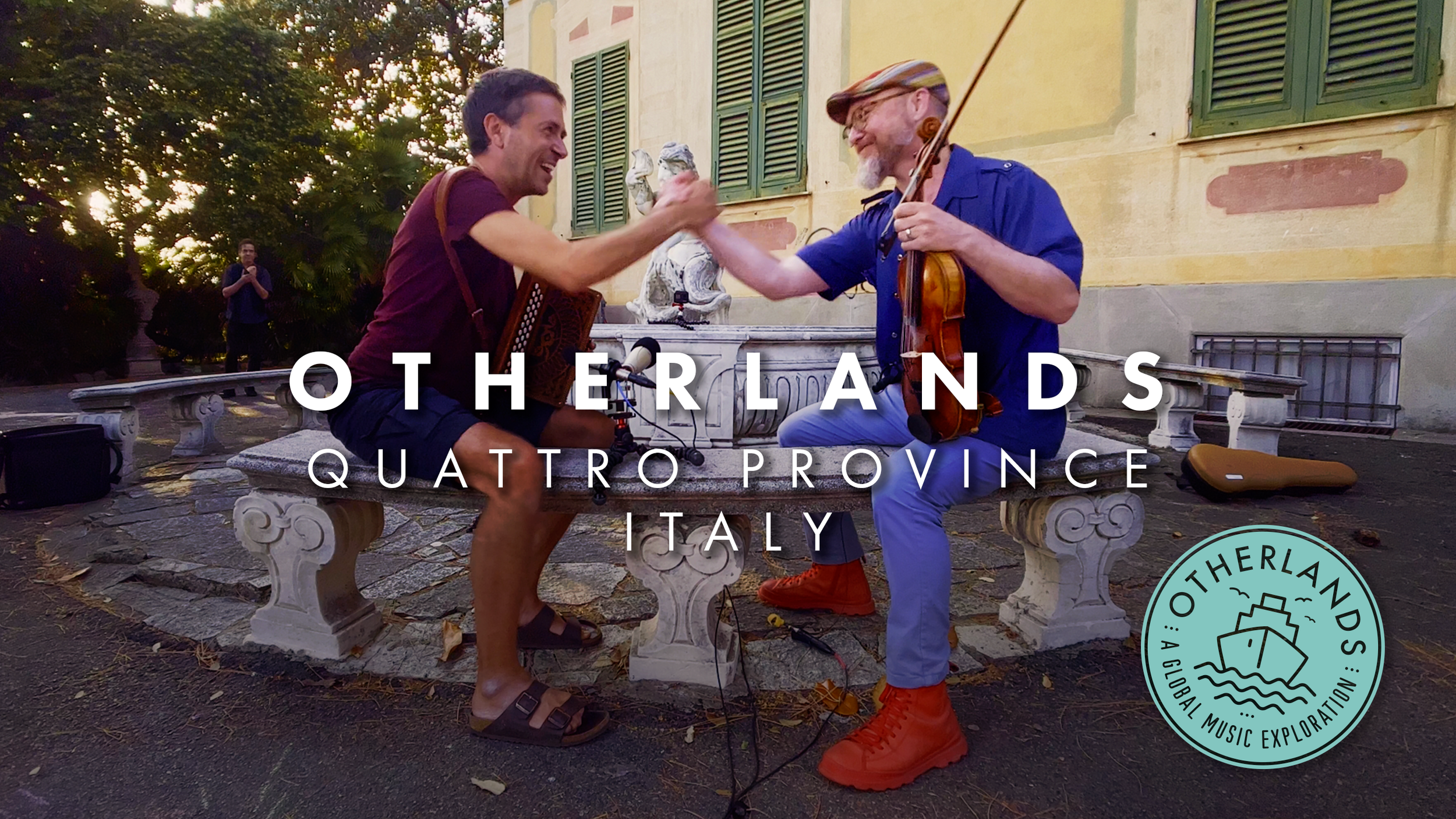
Quattro Province Dances • w/ Stefano Valla & Daniele Scurati


Otherlands Collaboration #30

Date: May 12, 2022 • Location: Cegni, Italy

I started heading north as soon as my ferry from Sardinia landed in Genoa, Italy. Driving through the Italian countryside into the Quattro Province area, I was off to find two masters of piffero music, Stefano Valla and Daniele Scurati.

[To learn more about their music, please visit their website or Instagram.]

The Quattro Province is an ancient cultural crossroads of four northern Italian regions — Liguria, Piedmont, Lombardy, and Emilia-Romagna — joined by the Apennine Mountains. Although consisting of different provinces, the people have shared similar ways of life for centuries, growing cereals, potatoes and chestnuts, raising sheep and cows, building typical villages, and even married across the upper valleys more than between these and the accompanying lowlands. This cultural unity is also well represented in the traditional music of the region.

“Part of a vital musical heritage in northern Italy and a cultural emblem of the [Quattro Province], the piffero is conically bored with a double-reed (musotto) inserted in a brass tube, itself contained in a wooden mushroom-shaped support (bocchetta), whose cylindrical stem fits tightly into the main body of the instrument. There are eight holes, including one on the back that is closed with the thumb. The end of the pipe has a bell traditionally decorated with a rooster’s tail feather, a tool used to clean and dry the reed.” (Songlines, May 11, 2021)

I threaded myself through narrow streets of towns and villages, past colorful buildings deceiving my eye with their trompe l’oeil style, towering steeples and forts, pergolas and fields bursting with color. Up I went, via steep switchbacks, wooded hillsides broken up by vineyards, until finally arriving to the small hamlet of Cegni (pop. 43). My final destination was the home of master pifferaio Stefano Valla, where we would be joined by accordionist Daniele Scurati for a quintessential duo of the region’s traditional dance music. I didn’t find this location on my own though, I was following Daniele, whom I had spent the morning with, performing for young children at the local schools.

Like seemingly all the homes in Cegni, Stefano’s was made of stone, and quite old. If I understood correctly, an inscription on a wall dated a renovation back to the 1870’s. We set up in his cozy dining room in a tight triangle and their powerful instruments (with volumes designed to play dances unamplified) filled the room. Over the course of the afternoon I got a sampling of four different types of dance tunes—a monferrina, waltz, polka, and a piana—all traditional—often “named” simply by the type of tune because the specific title has been lost. We also played a ballad composed by Stefano and Daniele, leading into the polka, and I taught them a Bill Monroe bluegrass waltz, Lonesome Moonlight Waltz.

Even though this collaboration was mostly tunes from the Quattro Province (which I loved learning), we really worked to create arrangements for our three instruments in contrast to me just playing along. I focused on learning forms, chords, and rhythms from Daniele’s harmony and bass lines, along with the occasional melody from Stefano. They really enjoyed my approach to rhythm and created spots in a couple different tunes where one would lay out, and I would accompany the other with chopping as a duo.

Musically, it was a very rich and rewarding day, and there was something really lovely about our synergy. I had some of my usual musical struggles, of course, like remembering forms and chords of multiple new tunes and trying to lock in with new rhythmic and melodic nuances. The most challenging for me was the piana, which had a way of changing between rhythms that I’d never experienced before. They were very patient and it was important to all of us to make the best music we could. In fact, a couple of these pieces will even be included in their upcoming album!

We finished our time at Stefano’s home with a bit of wine and headed off a nearby village to share a meal at an amazing restaurant. When communicating, if we reached our limit with english, we would fall back on a fun combination of their Italian or French while I would speak Spanish.

I learned that Stefano and Daniele still play long nights of dances locally. Once the dance is “over” after a few hours, everyone will retire to the priest’s house (which is currently empty because the church is without a priest) and the party will continue for hours more. By the end Daniele can’t feel his fingers and Stefano’s tongue may bleed.

I learned that the current standard instrumentation for piffero music is as a duo with accordion. However, it used to be with bagpipes. The transition to accordion allowed for more complex accompaniment while still retaining the feel of the dances.

I also learned that Ernesto Sala, one of the great piffero masters, was himself from Cegni and was Stefano’s teacher.

The next morning, Stefano invited me back to his home for a personal tour of Cegni. With my mind no longer singularly focused on learning and capturing music, I was able to notice and admire a special collection of black and white photos on his walls. My favorite was the image of young Stefano playing for a dance with an older accordionist, his parents one of the couples on the floor, and an even younger Daniele listening intently from the side, leaning forward to absorb the music and possibly manifesting his current musical partnership.

Among others, Stefano pointed out photos of family gatherings and processions of musicians, the first accordionist in piffero music, and his respected teacher Ernesto—the two of them together and Ernesto alone with his piffero, sitting on the bench of his front porch. It’s this bench that Stefano remembers watching Ernesto teach and play from, and being frightened of him as a boy, only to later become the one who would carry forward his tradition.

I asked Stefano to open his case so I could see his instrument, and when I was done admiring, he invited me downstairs. Beautifully displayed on a mantle were at least thirty pifferos, and hanging in a corner was their original musical partner, the bagpipe.

For the final stop of our stroll around Cegni, Stefano led me to the home of his teacher. It was undergoing some renovation so we couldn’t enter, but there was now a commemorative plaque with Ernesto’s name next to the door, and the bench from the picture in Stefano’s dining room had seemingly not moved, now empty as if to invite the next generation of pifferaios.

CREDITS

Songs: Alessandrina (Traditional) / Alberi Neri (Stefano Valla, Daniele Scurati) / Polca (Traditional)
Arranged by: Stefano Valla, Daniele Scurati, Casey Driessen
Piffero: Stefano Valla
Accordion: Daniele Scurati
Fiddle/Audio/Filming: Casey Driessen
Video Editing: Lauren Balthrop

Additional Music: Valzer in Gennaio (intro) / Piana (outro)

SPECIAL THANKS

Beppe Gambetta
Federica Calvina Prino
Filippo Gambetta

Sardinian National Anthem • with Elena Ledda & Mauro Palmas

Sardinian National Anthem • with Elena Ledda & Mauro Palmas

My first trip to Italy kicked off on the island of Sardinia where I met Elena Ledda and Mauro Palmas, two of the most respected musicians in traditional Sardinian music.

Hutsul Warrior Song for Ukraine • with Nikolaj, Marian, Martin & Michal

Hutsul Warrior Song for Ukraine • with Nikolaj, Marian, Martin & Michal

While in the Czech Republic a few months after Russia invaded Ukraine, a group of musicians from different cultures within the Carpathian Mountains (Valach from the Czech side and Hutsul from the Ukrainian) came together to play a Hutsul warrior song for Ukraine.